OpenLLMetry

OpenLLMetry is an open-source observability framework designed to provide visibility into applications built using Large Language Models (LLMs), Vector databases, AI Frameworks, and Protocol (MCP). Built on top of OpenTelemetry standards, it enables developers and operations teams to collect and analyze telemetry data such as traces, metrics, and application-specific events generated during interactions.
With OpenLLMetry, you can monitor the complete lifecycle of LLM requests, including prompt execution, model responses, latency, token usage, and errors. It also helps track how different components—such as LLM providers, APIs, vector databases, frameworks, and supporting services—interact within AI/ML applications.
By capturing these insights, OpenLLMetry helps you troubleshoot issues faster, optimize performance, and gain deeper visibility into AI/ML systems and LLM-powered workflows.
Setup
The OpenLLMetry SDK (Traceloop) uses the standard OpenTelemetry protocol, allowing you to use any OpenTelemetry collector. This provides flexibility to connect to any observability backend of your choice, such as Sumo Logic.
It supports SDKs in different languages Python, Golang, Next.js, Nodejs, and Ruby.
You can collect the data in two ways, either by setting up the destination as OpenTelemetry collector or as OTLP/HTTP source.
Set up the destination as OpenTelemetry collector
- Install the Sumo Logic OpenTelemetry collector with the default configuration.
- Install the OpenLLMetry SDK on host.
pip install traceloop-sdk - Set environment for collector otlp endpoint.
export TRACELOOP_BASE_URL="http://localhost:4318" - Instrument your application for OpenLLMetry.
from traceloop.sdk import Traceloop
Traceloop.init()
Set up the destination as the OTLP/HTTP source
-
Install the Sumo Logic hosted collector.
-
Create Sumo Logic OTLP/HTTP Source under Hosted Collector.
-
Click the Show URL option against your selected source on your OTLP/HTTP source page.

-
Use any of the following address type to configure the instrumentation code:
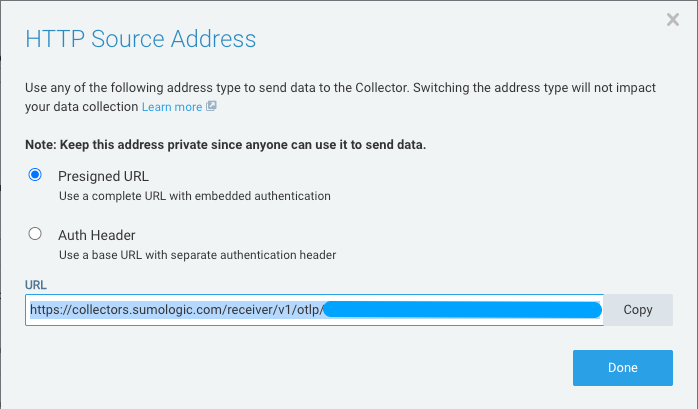
- Presigned URL
-
Copy and save the complete URL with embedded authentication.
-
Enter the copied URL in the traces instrumentation code:
OTLP_ENDPOINT="https://collectors.sumologic.com/receiver/v1/otlp/<TOKEN>"
Traceloop.init(
    app_name="http-trace-demo",
    api_endpoint=OTLP_ENDPOINT,
)
or
OTLP_ENDPOINT="https://collectors.sumologic.com/receiver/v1/otlp/<TOKEN>/v1/traces"
Traceloop.init(
    app_name="http-trace-demo",
    api_endpoint=OTLP_ENDPOINT,
)
-
- Auth Header
- Copy the header and base URL details to use the base URL with separate authentication header.
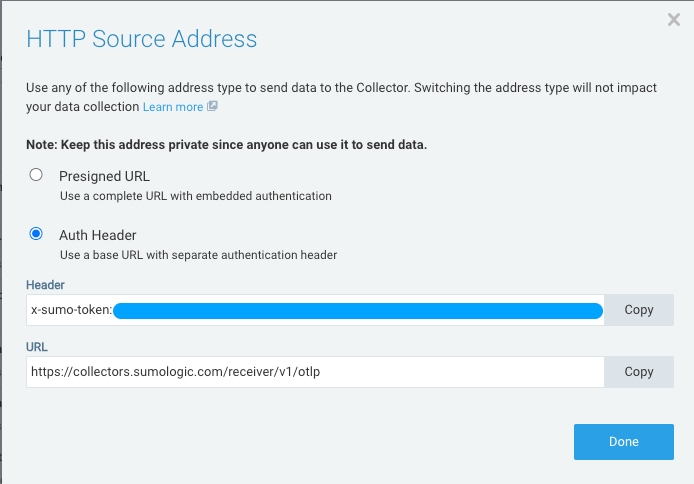
- Enter the header and base URL details in the trace instrumentation code:
HTTP_SOURCE_TOKEN = "<TOKEN>"
OTEL_EXPORTER_OTLP_ENDPOINT="https://collectors.sumologic.com/receiver/v1/otlp"

Traceloop.init(
    app_name="http-trace-with-auth-header-demo",
    api_endpoint=OTEL_EXPORTER_OTLP_ENDPOINT,
    headers={"x-sumo-token": HTTP_SOURCE_TOKEN},
    disable_batch=True
)
- Copy the header and base URL details to use the base URL with separate authentication header.
infoFor logs and metrics, refer to the URL format in Data Differentiation.
- Presigned URL
Instrument sample application for OpenLLMetry
The following sample code demonstrates a practical implementation of Chroma as a vector database.
Prerequisites
Before running the code, install the required libraries:
pip install chromadb sentence-transformers traceloop-sdk
- Chroma: Used to store and query document embeddings for semantic search.
- SentenceTransformers: Generates embeddings using the model
all-MiniLM-L6-v2. - OpenLLMetry(Traceloop): Adds observability to the workflow by tracing tasks using OpenTelemetry.
How it works
This example demonstrates a practical implementation of a vector search system using the Chroma with a local embedding model.
Step 1: Initialize tracing
The application initializes Traceloop to enable observability and trace the workflow and tasks during execution. The OpenLLMetry SDK(Traceloop) is configured to export telemetry data using the OpenTelemetry protocol(OTLP).
The following two configurations are supported:
- For OpenTelemetry collector, the endpoint connects to
http://localhost:4318, and the Sumo Logic exporter forwards the collected data to the SaaS platform. - For OTLP/HTTP source, the endpoint connects to
https://collectors.sumologic.com/receiver/v1/otlp.
Step 2: Load the embedding model
- The embedding model
all-MiniLM-L6-v2is loaded using SentenceTransformers. - This model converts text into vector embeddings that can be used for semantic search and similarity comparison.
Step 3: Create a vector collection
- A collection named
company_datais created in Chroma. - This collection stores documents and their corresponding vector embeddings.
Step 4: Store documents
- Sample documents describing companies are added to the collection.
- Each document is automatically converted into a vector embedding using the embedding model.
Step 5: Perform a semantic query
When you submit a question:
- The query is converted into an embedding.
- Chroma performs a similarity search against the stored document embeddings.
Step 6: Return relevant results
The system returns the top matching documents that are semantically similar to the query. This enables efficient retrieval of relevant information based on meaning rather than exact keyword matches.
Demonstration code for OpenTelemetry collector
OpenTelemetry collector
 import chromadb
 from chromadb.utils import embedding_functions

 from traceloop.sdk import Traceloop
 from traceloop.sdk.decorators import workflow, task

 Traceloop.init(app_name="openllmetry-trace-demo")

 # Local embedding model (runs locally)
 hf_ef = embedding_functions.SentenceTransformerEmbeddingFunction(
     model_name="all-MiniLM-L6-v2"
 )

 @task(name="create_collection")
 def create_collection():
     client = chromadb.Client()

     collection = client.get_or_create_collection(
         name="company_data",
         embedding_function=hf_ef
     )

     collection.add(
         documents=[
             "Sumologic provides software intelligence and observability solutions.",
             "OpenAI develops artificial intelligence models.",
             "AWS provides cloud infrastructure services."
         ],
         ids=["1", "2", "3"]
     )
     return collection


 @task(name="query_collection")
 def query_collection(question):
     collection = create_collection()

     results = collection.query(
         query_texts=[question],
         n_results=2
     )

     return results


 @workflow(name="chromadb_search")
 def search_company_info():
     question = "What does Sumologic do?"
     return query_collection(question)


 if __name__ == "__main__":
     print(search_company_info())
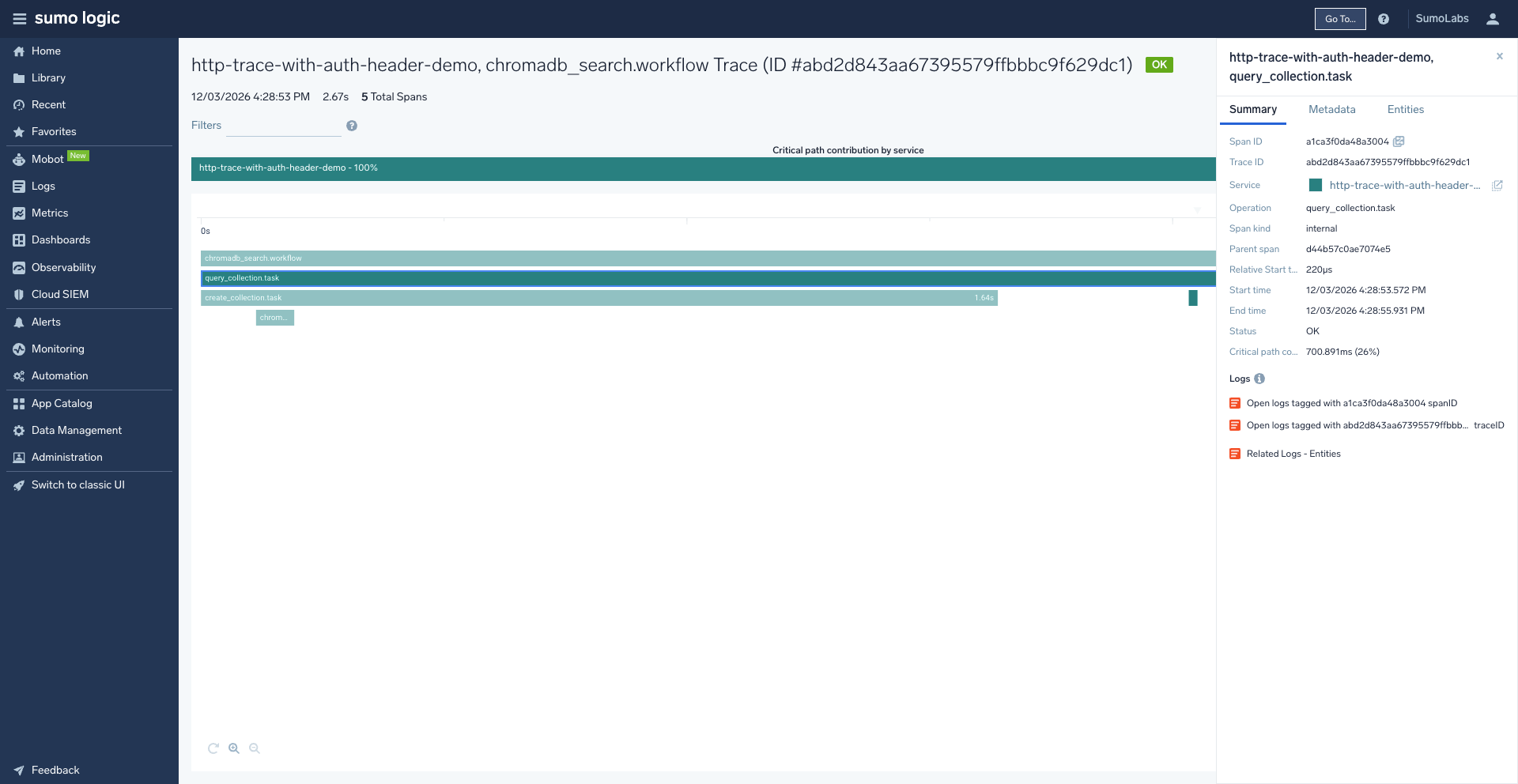
Trace overview
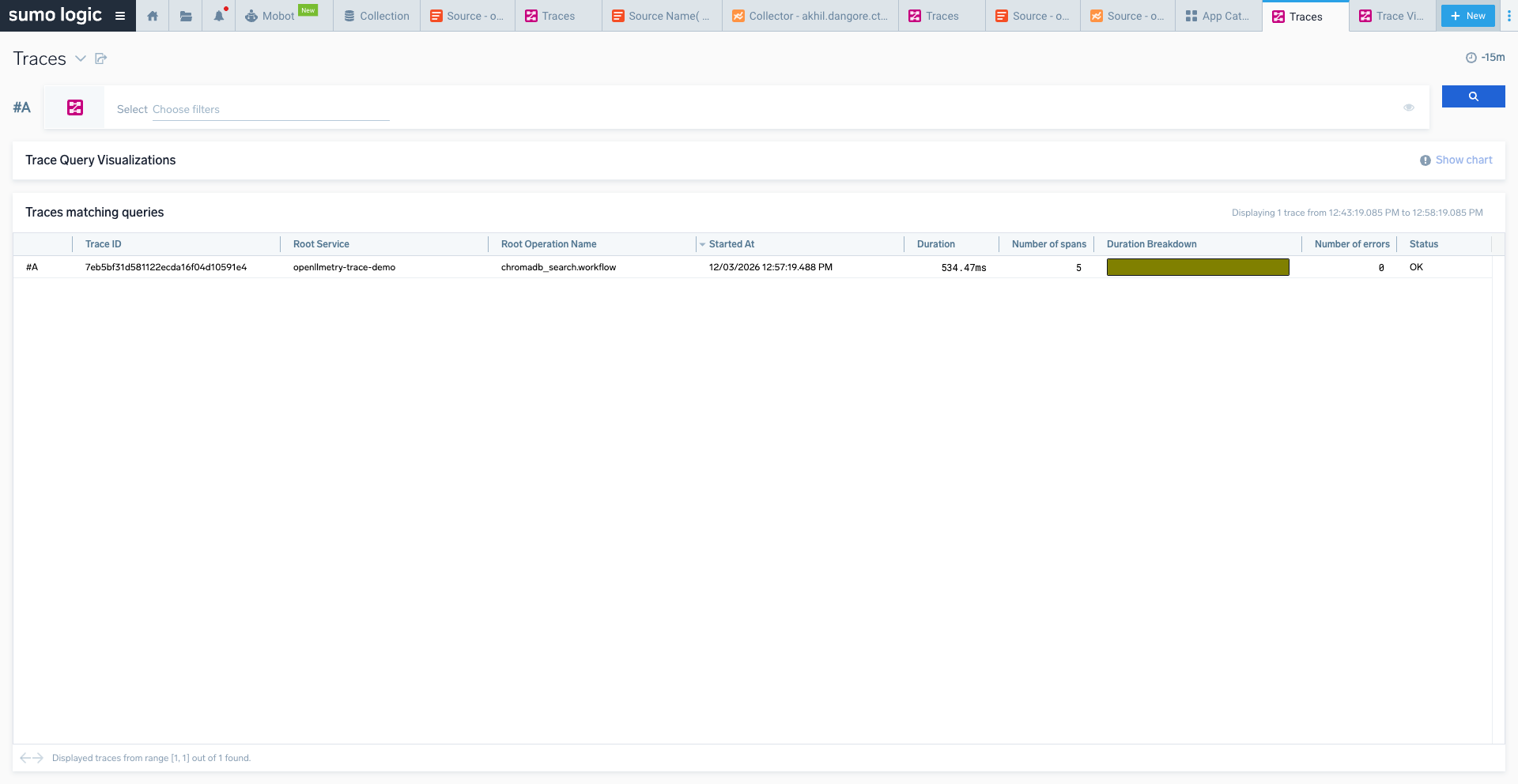
Trace view detail

Demonstration code for OTLP/HTTP source with Auth-Header
OTLP/HTTP source-auth header
import chromadb
from chromadb.utils import embedding_functions

from traceloop.sdk import Traceloop
from traceloop.sdk.decorators import workflow, task

HTTP_SOURCE_TOKEN = "<TOKEN>"
OTEL_EXPORTER_OTLP_ENDPOINT="https://collectors.sumologic.com/receiver/v1/otlp"

Traceloop.init(
    app_name="http-trace-with-auth-header-demo",
    api_endpoint=OTEL_EXPORTER_OTLP_ENDPOINT,
    headers={"x-sumo-token": HTTP_SOURCE_TOKEN},
    disable_batch=True
)


# Local embedding model (runs locally)
hf_ef = embedding_functions.SentenceTransformerEmbeddingFunction(
    model_name="all-MiniLM-L6-v2"
)

@task(name="create_collection")
def create_collection():
    client = chromadb.Client()

    collection = client.get_or_create_collection(
        name="company_data",
        embedding_function=hf_ef
    )

    collection.add(
        documents=[
            "Sumologic provides software intelligence and observability solutions.",
            "OpenAI develops artificial intelligence models.",
            "AWS provides cloud infrastructure services."
        ],
        ids=["1", "2", "3"]
    )
    return collection


@task(name="query_collection")
def query_collection(question):
    collection = create_collection()

    results = collection.query(
        query_texts=[question],
        n_results=2
    )

    return results


@workflow(name="chromadb_search")
def search_company_info():
    question = "What does Sumologic do?"
    return query_collection(question)


if __name__ == "__main__":
    print(search_company_info())
Trace overview
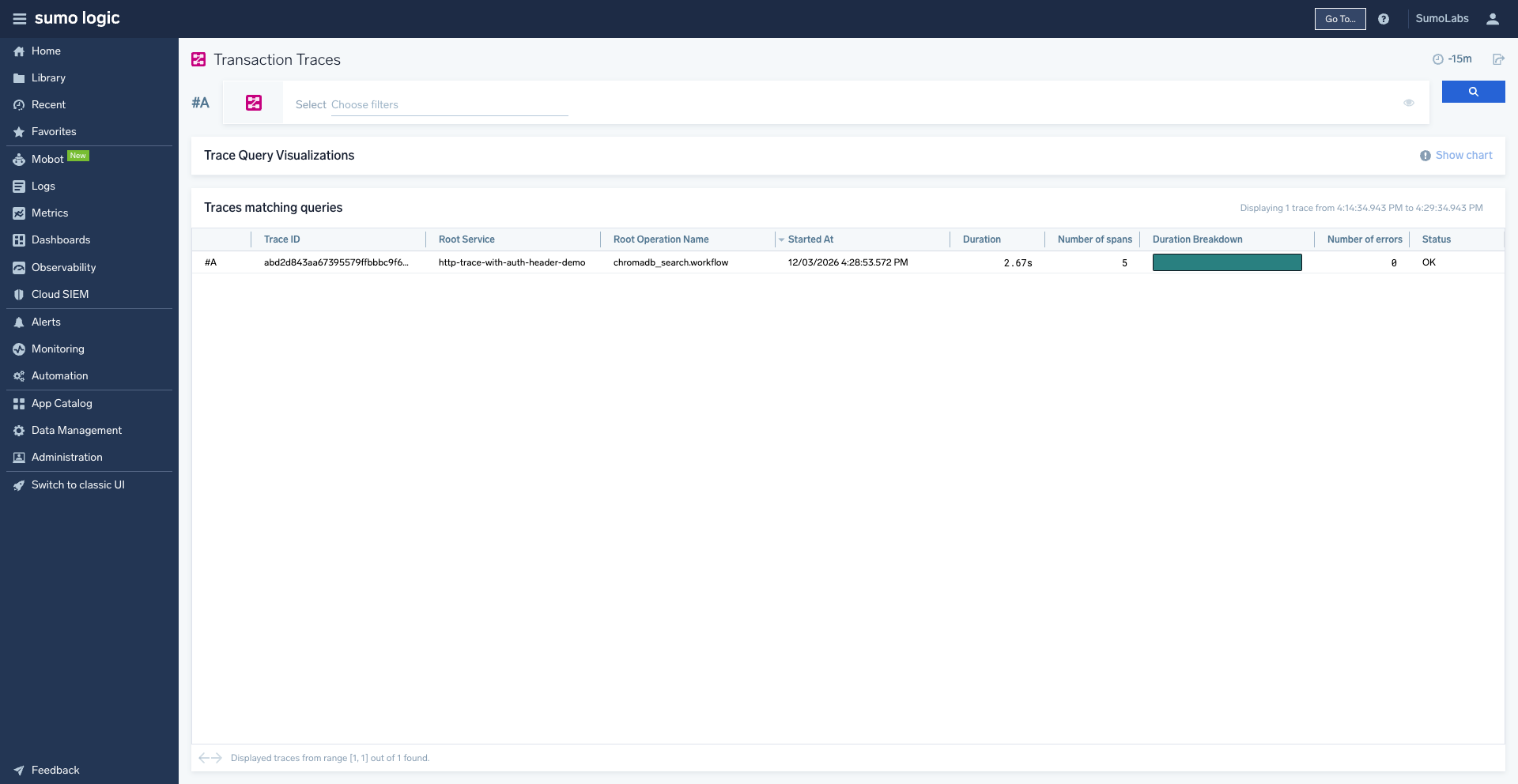
Trace view detail