macOS - OpenTelemetry Collector


The Sumo Logic app for macOS allows you to monitor the performance and resource utilization of hosts and processes that your mission-critical applications are dependent upon.
The app consists of predefined searches and dashboards that provide visibility into your environment for real-time or historical analysis. Our dashboards provide insight into CPU load, memory, network, file descriptors, page faults, and TCP connectors. This app uses OpenTelemetry, an open-source collector for metrics.
We use the Sumo Logic Distribution for OpenTelemetry Collector for metrics collection.
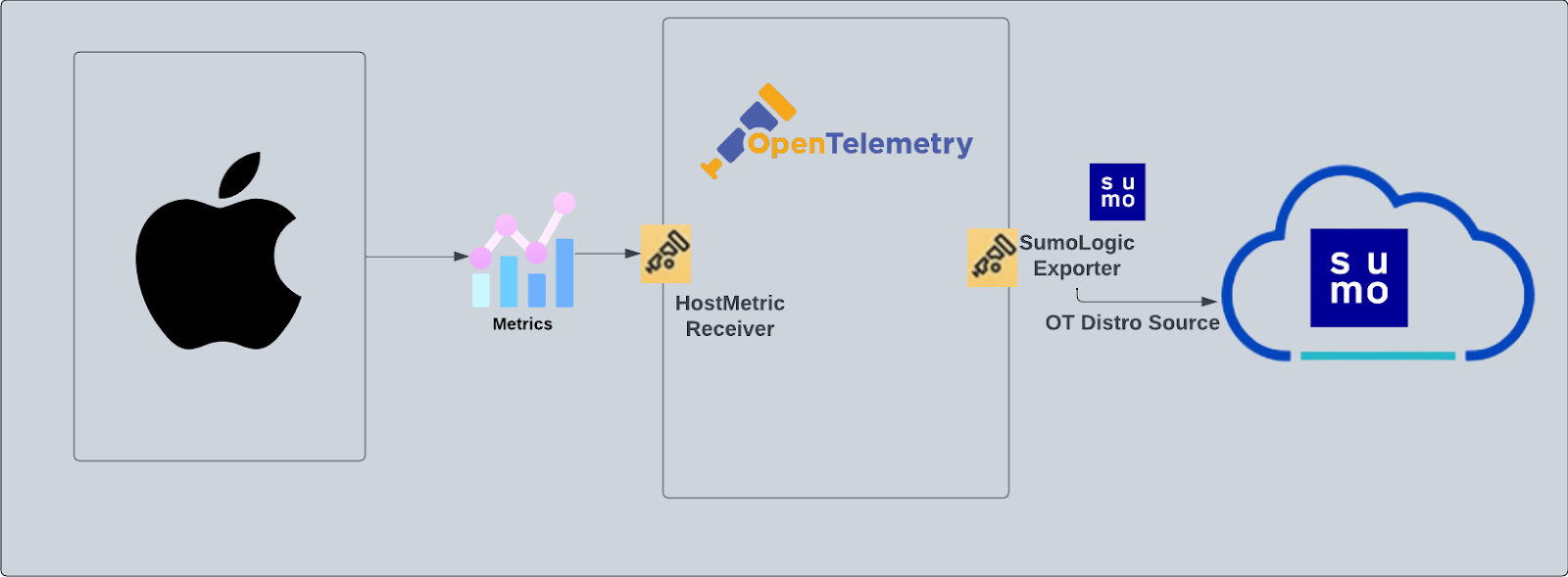
The OpenTelemetry collector runs on the macOS machine, and uses the Host Metrics Receiver to obtain host and process metrics, and the Sumo Logic OpenTelemetry Exporter to send the metrics to Sumo Logic.
This app includes built-in monitors. For details on creating custom monitors, refer to Create monitors for macOS app.
Fields Created in Sumo Logic for macOS
Following are the fields which will be created as part of the macOS app install, if not already present.
sumo.datasource. Has a fixed value ofmac.deployment.environment. This is a collector level field and is user configured (at the time of collector installation). Through this, the mac host cluster is identified by the environment where it resides. For example:dev,prod, orqa.host.group. This is a collector level field and is user configured (at the time of collector installation). Through this, the mac host cluster is identified.host.name. This is tagged through theresourcedetectionprocessor. It holds the value of the host name where the OTel collector is installed.
Collection configuration and app installation
Follow these steps to set up and deploy the source template to collect data in Sumo Logic from a remotely managed OpenTelemetry collector.
Step 1: Set up remotely managed OpenTelemetry collector
If you want to configure your source locally, you can do so by downloading the YAML file. For details, see Configure OpenTelemetry collectors locally.
In this step, we'll install remotely managed OpenTelemetry collector and add a uniquely identifiable tag to these collectors.
- Classic UI. In the main Sumo Logic menu, Select App Catalog.
New UI. In the Sumo Logic main menu select App Catalog. - In the 🔎 Search Apps field, run a search for your desired OpenTelemetry app, then select it. For example, Apache - OpenTelemetry.
- Click the Manage dropdown and then select Add Collection.
- On the Set Up Collector page, select Add a New Collector and then click Next.
If you want to use an existing OpenTelemetry Collector, you can skip this step by selecting the Use an existing Collector option.
- Select the platform where you want to install the Sumo Logic OpenTelemetry Collector. For example, Linux.
This will generate a command that you can execute in the machine environment you need to monitor. Once executed, it will install the Sumo Logic OpenTelemetry Collector.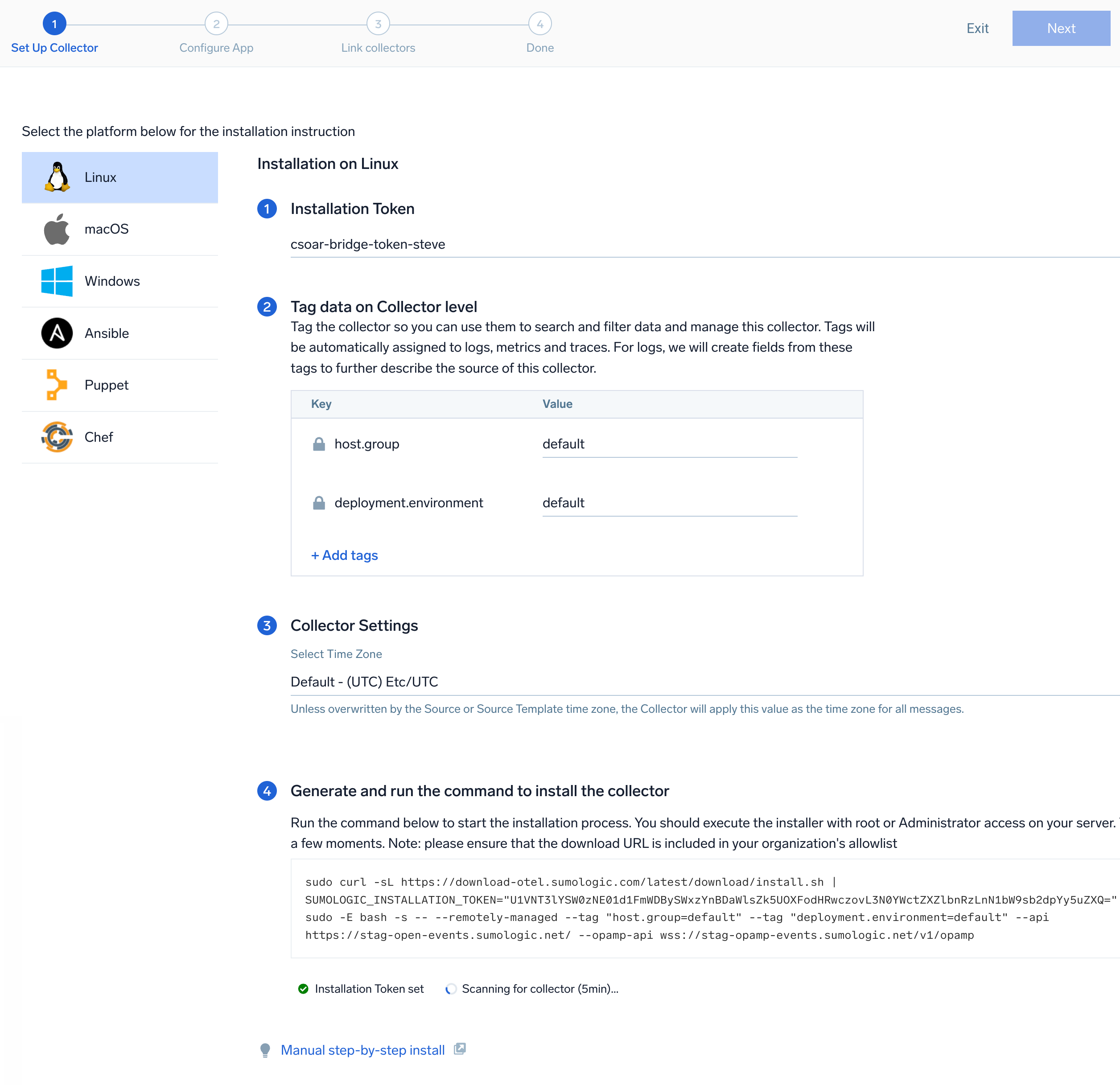 The installation commands now include a
 --remotely-managedflag. When this flag is used, a remotely managed collector is installed automatically instead of a locally managed one. If you prefer to use a locally managed collector, simply remove the flag from the installation command.
Step 2: Configure the source template
In this step, you will configure the YAML required for Mac Collection. Below are the inputs required for configuration:
- Name. Name of the source template.
- Description. Description for the source template.
Logs collection
- Fields/Metadata. You can provide any customer fields to be tagged with the data collected. By default, sumo tags
_sourceCategorywith the value otel/mac. - Logs. The following fields are pre-populated with default paths for common log files that are used in different Mac distributions. Not all paths might be relevant for your operating system. Modify the list of files as required or leave the default values.
Metrics collection
- Metrics. Select the metric scrappers you want to enable. By default, metric collection for memory, load, file system, network and paging are enabled and process metric collection is disabled.
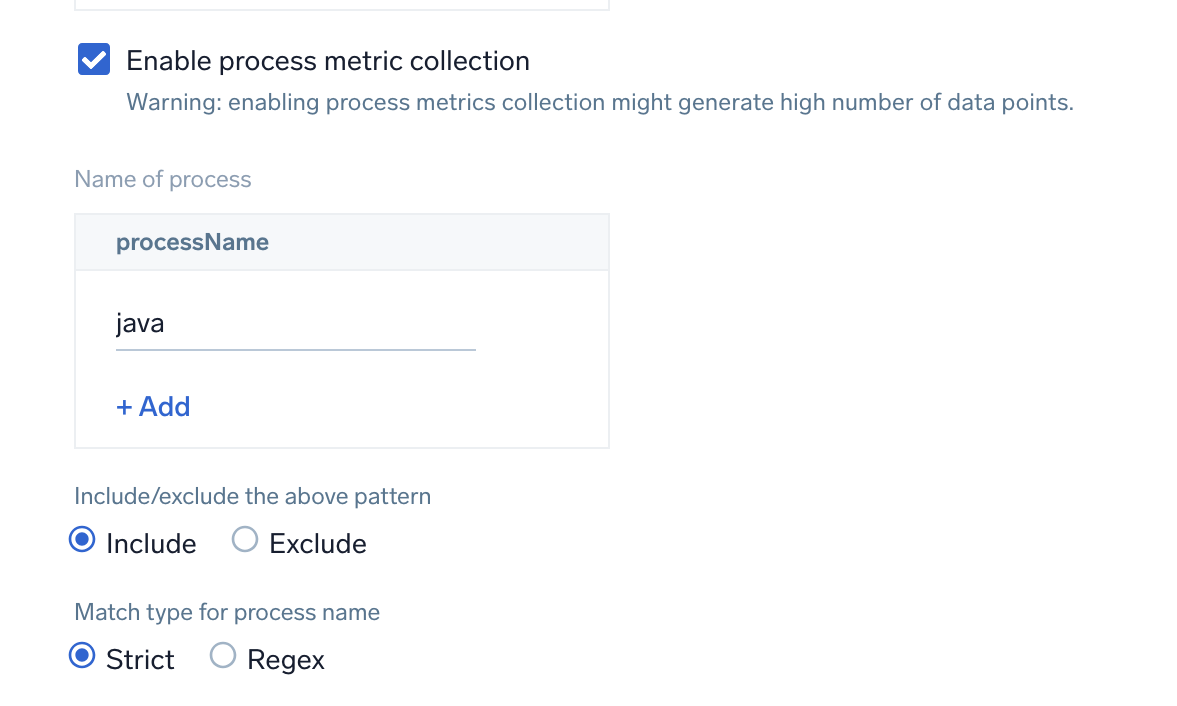
Enable process metric collection (Optional)
By default, the collector will not send process metrics to Sumo Logic. This is because the number of processes running on a host can be very large, which would result in a significant increase in Data Points per Minute (DPM).
Click the Enable process metric collection checkbox to collect process-level metrics.
- Name of process. Add the list of process names.
- Include/Exclude the above pattern. Signifies if you want to exclude or include the metrics for the processes listed previously.
- Match type for process name. Select if the process name given should be considered for a strict match with the host machine processes or if it should be considered as regex when matching.
If you need to edit the process list in the future, you can do this manually in the OTEL config yaml by adding or removing in the names list under process scrapper.
process:
  include:
    names: [ <process name1>, <process name2> ... ]
    match_type: <strict|regexp>
- Scan Interval. The frequency at which the source is scanned.
- Processing Rules. You can add processing rules for logs/metrics collected. To learn more, refer to Processing Rules.
Step 3: Push the source template to the desired remotely managed collectors
A new source template will always be created with the latest version of the source template.
Follow the below steps to create a data collection configuration to gather the required logs and link them to all the collectors with the help of collector tags.
- Complete the source template form with the name and file path for your logs (for example, error logs or access logs), then click Next.
- Under Link Collectors, you will have the option to link the collectors using the collector name or by adding tags to find the group of collectors (for example,
application = Apache).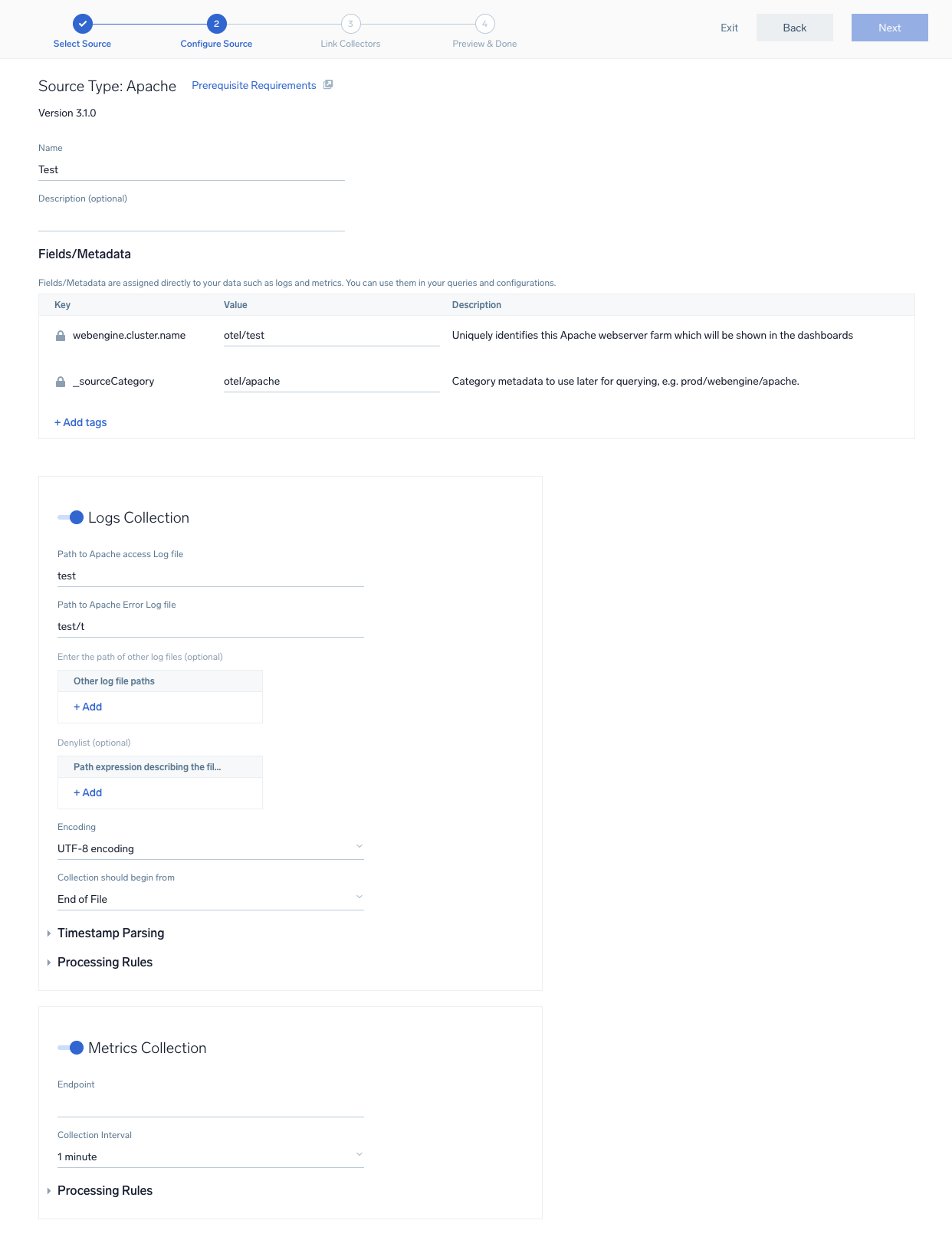
- Preview and confirm the collectors that will be linked (fetched automatically) to the newly created source template.
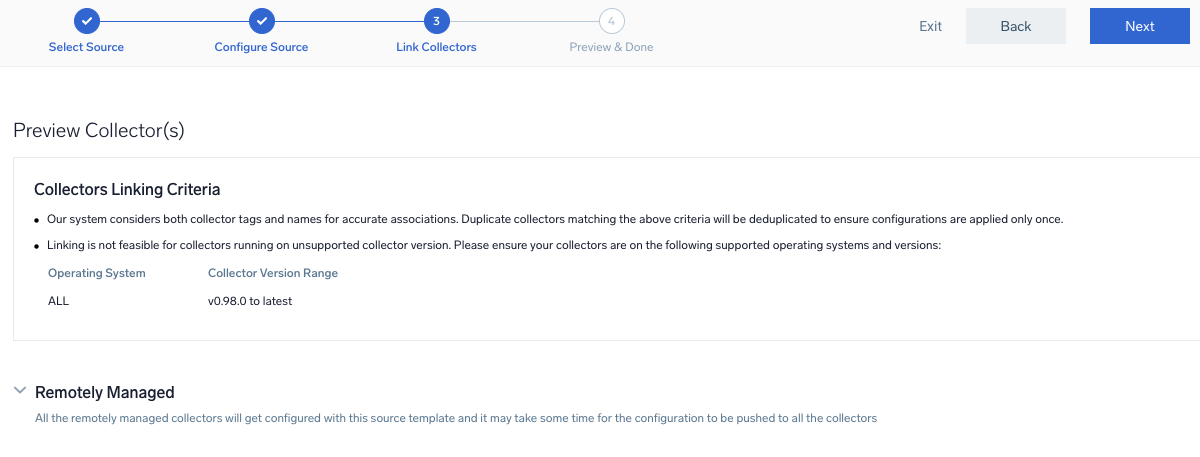
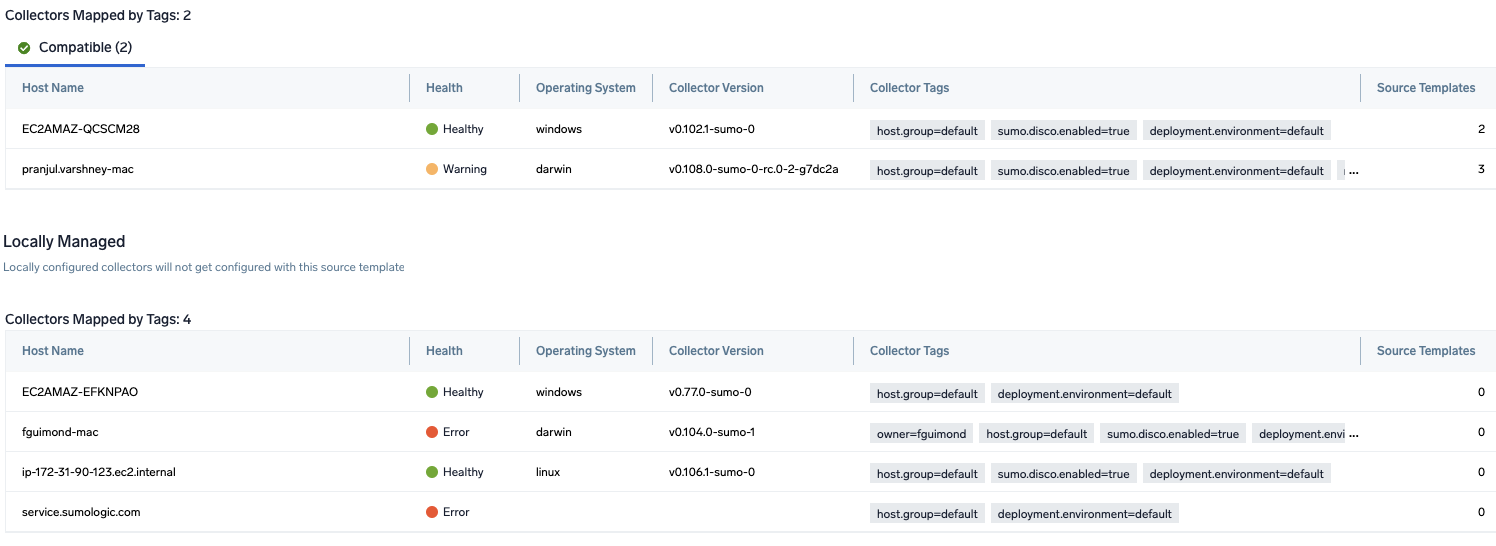
- Click Next to complete the source template creation. In the background, the system will apply the configuration to all the linked collectors and will start collecting the respective telemetry data from the remote host (in the example, it would start collecting Apache error logs).
- Click the Log Search or Metrics Search icons to search for and analyze your data collected for this source template.
Sample metrics
{
	"queryId":"A",
	"_source":"sumo-mac-dc8d7942-8038-46f0-af33-9a3a06a73f72",
	"state":"LAST_ACK",
	"_sourceName":"sumomacsyslog",
	"host":"sumo-mac",
	"os.type":"darwin",
	"sumo.datasource":"mac",
	"_sourceCategory":"sumo/mac/sys/logs",
	"metric":"system.network.connections",
	"_collectorId":"000000000CAADE8D",
	"_sourceId":"0000000000000000",
	"unit":"{connections}",
	"_sourceHost":"sumo-mac",
	"_collector":"sumo-mac-dc8d7942-8038-46f0-af33-9a3a06a73f72",
	"protocol":"tcp",
	"max":0,
	"min":0,
	"avg":0,
	"sum":0,
	"latest":0,
	"count":14
}
Sample queries
Metrics query from the File System Utilization panel.
sumo.datasource=mac host.name=* device=* metric=system.filesystem.utilization | sum by host.name, device, type, mountpoint
Viewing macOS dashboards
All dashboards have a set of filters that you can apply to the entire dashboard. Use these filters to drill down and examine the data to a granular level.
- You can change the time range for a dashboard or panel by selecting a predefined interval from a drop-down list, choosing a recently used time range, or specifying custom dates and times. Learn more.
- You can use template variables to drill down and examine the data on a granular level. For more information, see Filtering Dashboards with Template Variables.
Host Metrics - Overview
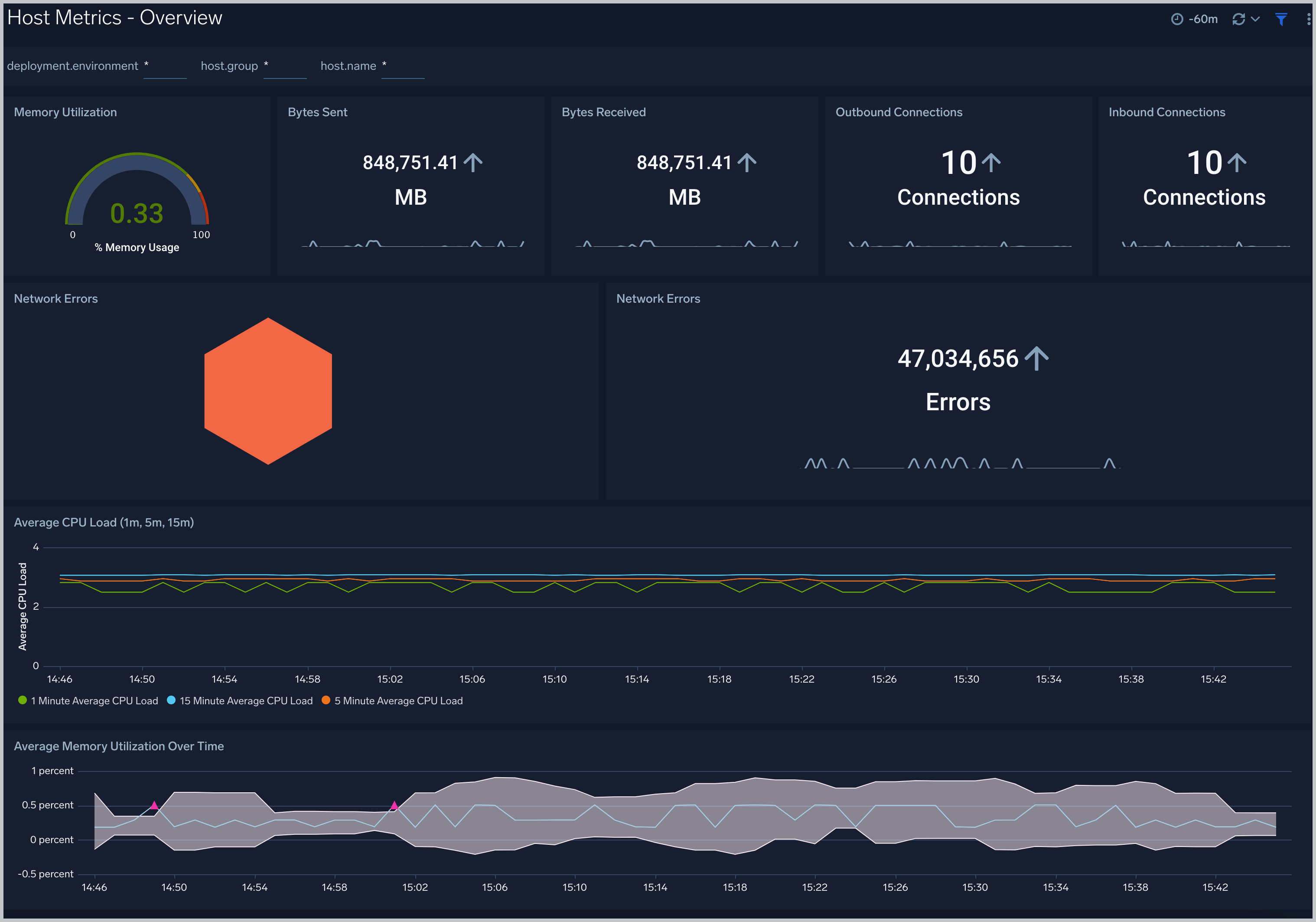
The Host Metrics - Overview dashboard gives you an at-a-glance view of the key metrics like CPU load, memory, network, and TCP connections of all your macOS hosts. Use this dashboard to identify hosts with high CPU load, memory utilization, and identify anomalies over time.
Host Metrics - CPU
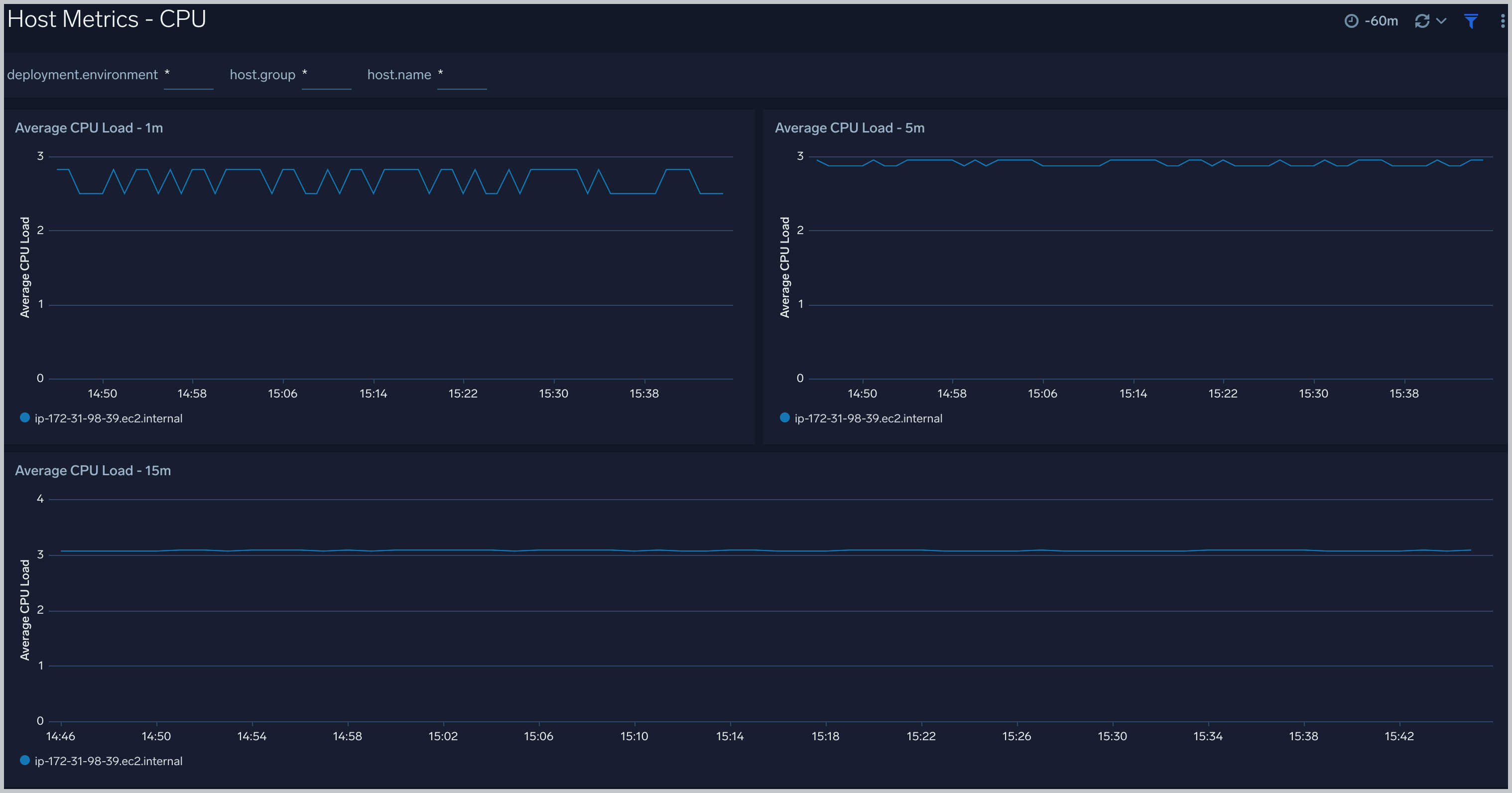
The Host Metrics - CPU dashboard provides the metric over time for CPU load. Use this dashboard to identify hosts and processes with high CPU utilization.
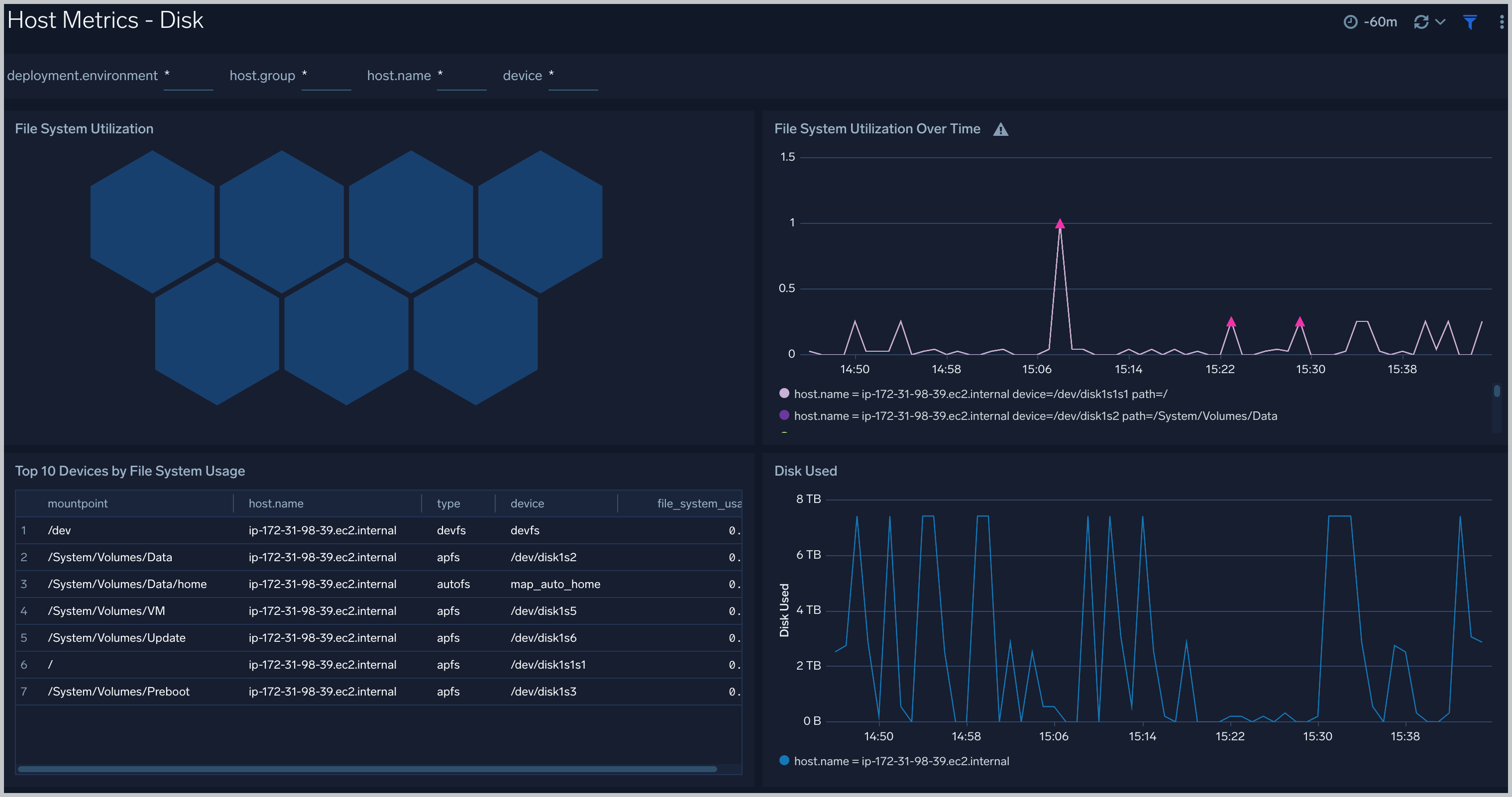
Host Metrics - Disk
The Host Metrics - Disk dashboard provides detailed information about file system metrics.
Use this dashboard to view:
- File system utilization over time.
- Devices by file system usage.
- Disk used by host.
Host Metrics - Memory
The Host Metrics - Memory dashboard provides detailed information on host memory usage, memory distribution, and used free and Inactive memory.
Use this dashboard to:
- Identify hosts with high memory utilization.
- Examine memory distribution (free, used) for a given host.
- Total free used and inactive memory.
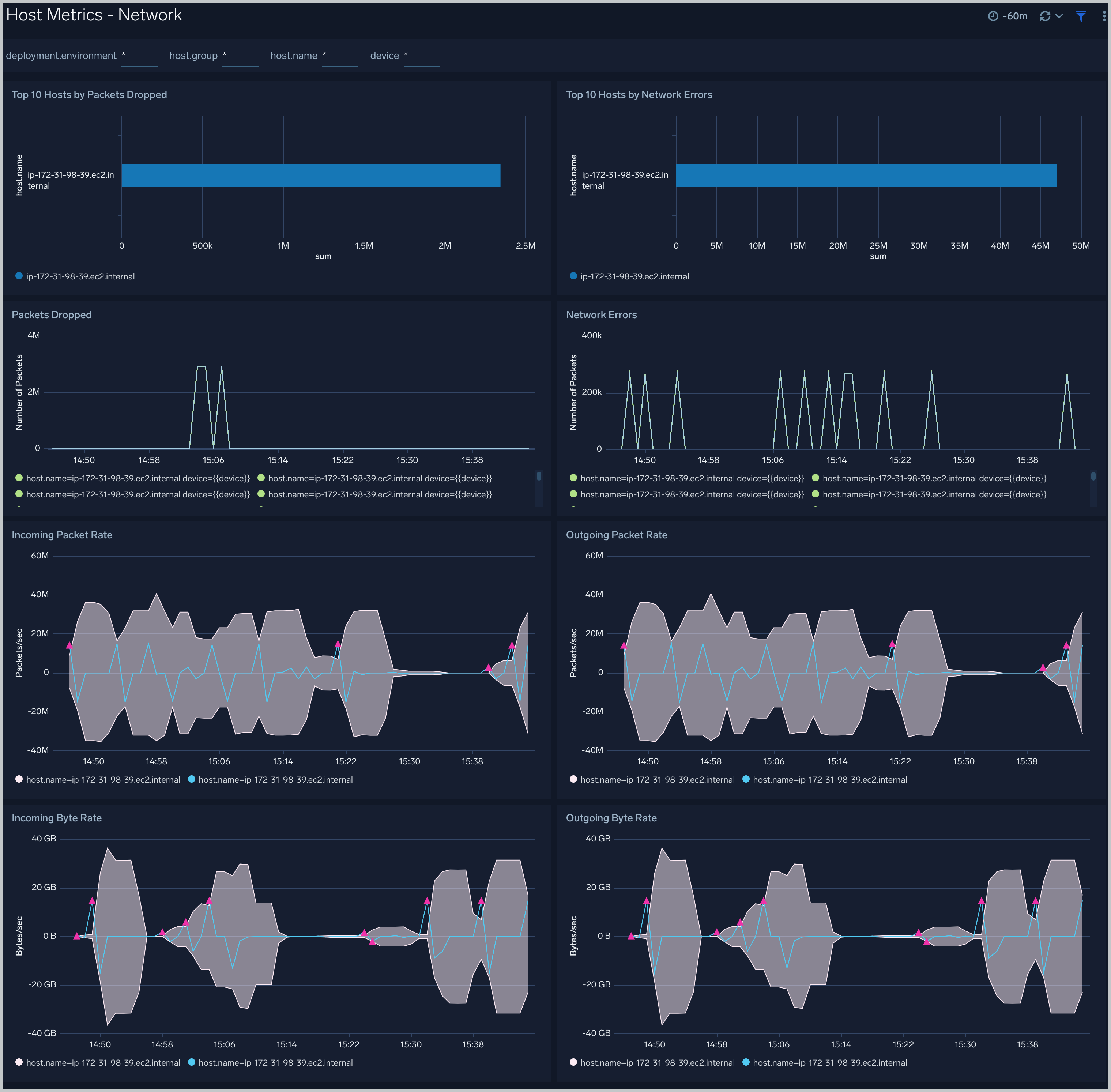
Host Metrics - Network
The Host Metrics - Network dashboard provides detailed information on host network errors, throughput, and packets sent and received.
Use this dashboard to:
- Determine top hosts with network errors and dropped packets.
- Monitor abnormal spikes in incoming/outgoing packets and bytes sent and received.
- Use dashboard filters to compare throughput across the interface of a host.
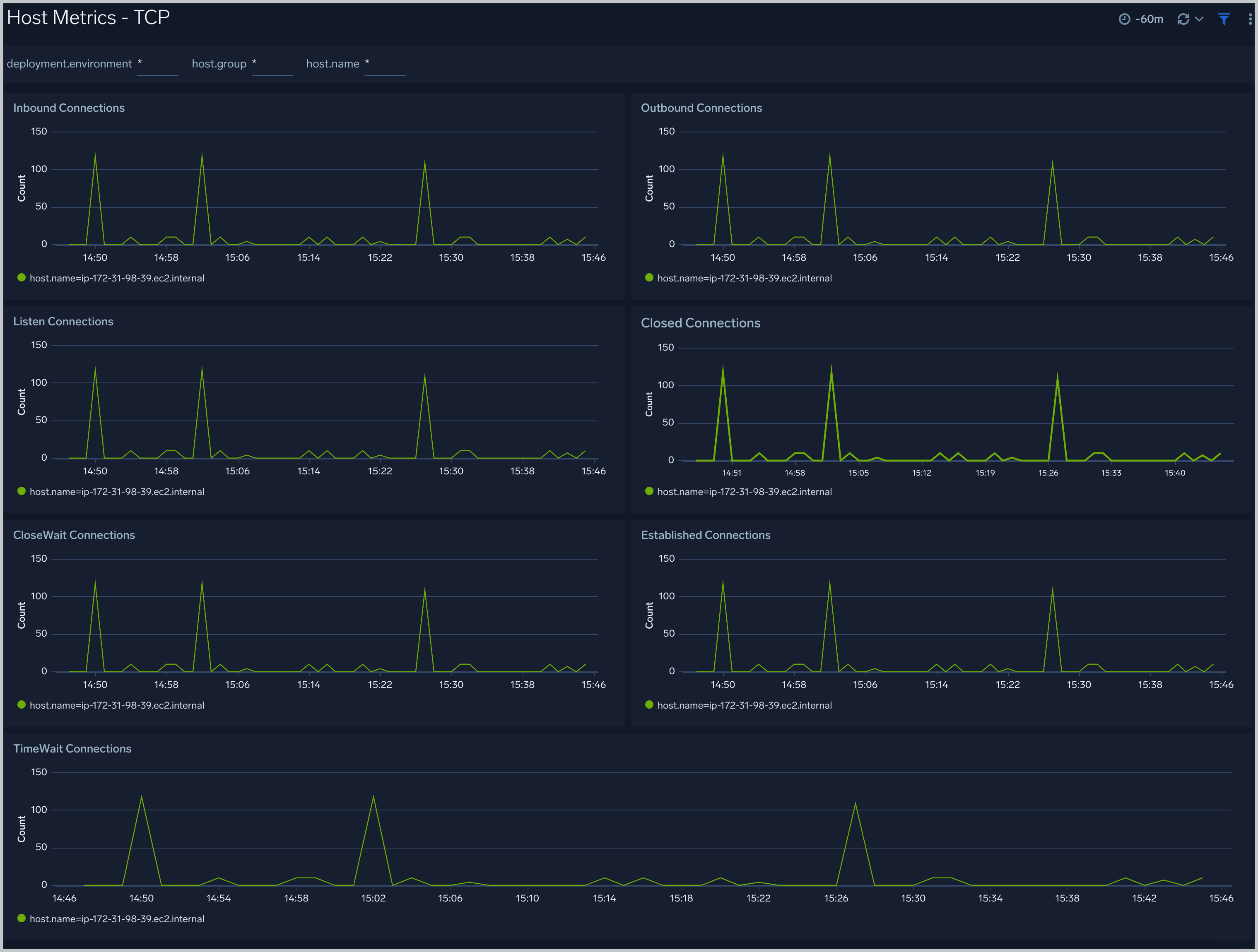
Host Metrics - TCP
The Host Metrics - TCP dashboard provides detailed information about inbound, outbound, open, and established TCP connections.
Use this dashboard to:
- Identify abnormal spikes in inbound, outbound, open, or established connections.
Create monitors for macOS app
From your App Catalog:
- From the Sumo Logic navigation, select App Catalog.
- In the Search Apps field, search for and then select your app.
- Make sure the app is installed.
- Navigate to What's Included tab and scroll down to the Monitors section.
- Click Create next to the pre-configured monitors. In the create monitors window, adjust the trigger conditions and notifications settings based on your requirements.
- Scroll down to Monitor Details.
- Under Location click on New Folder.
note
By default, monitor will be saved in the root folder. So to make the maintenance easier, create a new folder in the location of your choice.
- Enter Folder Name. Folder Description is optional.
tip
Using app version in the folder name will be helpful to determine the versioning for future updates.
- Click Create. Once the folder is created, click on Save.
macOS alerts
| Alert Name | Alert Description and conditions | Alert Condition | Recover Condition |
|---|---|---|---|
Metrics Mac - High FileSystem Utilization Alert | This alert gets triggered when filesystem utilization exceeds threshold. | Count > 80 | Count < = 80 |
Mac - High Memory Utilization Alert | This alert gets triggered when memory utilization exceeds threshold. | Count > 80 | Count < = 80 |