Tool proliferation is compounding. Alerts are multiplying faster than teams can triage them. Visibility gaps are hiding real threats. And security teams are stuck babysitting archaic security infrastructure, rather than detecting and stopping threats.
Organizations across gaming, fintech, and retail are feeling the weight of traditional, on-premises SIEMs. Different industries, different team sizes, different environments, but the effects are similar: alert fatigue, tool sprawl, and platforms that create work instead of automating it.
So what happens when your SOC finally gets a SIEM that works and scales with you? Security analysts can automate security operations to prioritize key alerts, accelerate incident detection and response, and be more productive in their day-to-day.
Three companies across three industries made the shift to a modernized, AI-powered, cloud-native SIEM, and what they found on the other side was greater visibility and faster incident detection and response.
Traditional SIEMs are slowing down modern SOCs
55% of security leaders struggle with too many point solutions in their security stack.
Siloed tools can quickly slow your team down and cause burnout. Every new security tool added creates its own alert stream, dashboard, and learning curve. Analysts are forced to manually connect the dots, which can quickly lead to missed threats as they become too fatigued chasing false positives.
The road to intelligent security operations starts with rethinking your foundation.
“Before, we’d have to look through six or seven alerts, with five of those being unhelpful. That’s no longer the case with Sumo Logic. It’s helped uplift the team, who are eager to explore the service’s capabilities. It’s empowering them to do their jobs better than before.”
– Alvin Lim, Head of Information Security at Endowus.
Three companies that matured their SecOps with Cloud SIEM
Gaming: from unreliable logs to full visibility in five days
Patrianna’s previous security tools couldn’t reliably ingest logs or integrate with its Google-hosted environment. After switching to Sumo Logic, they were fully operational within five days. Using pre-configured dashboards, they gained visibility into login activity, user behavior, and geographic access patterns.
More than just log management, Patrianna uses Sumo Logic to “watch the watcher.” They can monitor their own SOC, gaining transparency into how analysts respond to alerts and the timeliness of their actions, ensuring that no unauthorized changes to data or configurations occur, all in one centralized platform.
Retail: cut log analysis time from five minutes to seconds
For lean security teams, manually managing an on-premise SIEM can stretch you thin.
As retailer DXL scaled and adopted more cloud services, their old security tool couldn’t keep up. They experienced occasional system downtime due to manual product updates and storage limitations, which slowed the team down.
Moving to Sumo Logic cut log analysis time from five minutes to seconds and gave the team real-time visibility. In one instance, log correlation identified a misconfiguration that generated 50 to 100 access denied errors per minute, something that would have gone entirely undetected with their previous setup.
“There hasn’t been anything I’ve thrown at Sumo Logic that it couldn’t handle. No matter how simple or complex the tech stack, it ingests, normalizes, and reports on the data exactly how we need it, making our lives a whole lot easier. And the support we’ve received along the way has been some of the best I’ve seen from any partnership I’ve had with any product I use.”
— John Sacchetti, Director of Cybersecurity and Networking at DXL.
FinTech: reduced alert investigation time by 90%
Tool sprawl can also prevent you from gaining full visibility into your environments. Endowus deployed multiple security solutions for email security and data loss prevention, resulting in a flood of alerts. Analysts were burnt out as they had to constantly monitor and fine-tune alerting systems across multiple dashboards, making security management complex and time-consuming.
After consolidating onto Sumo Logic Cloud SIEM, they reduced their alert investigation time by 90%. Benign alerts are resolved in just five to ten minutes, allowing the team to focus on real threats. Endowus gains a comprehensive view of their security landscape, helping them trace attack vectors and identify root causes of incidents. By integrating data from their various tools into Sumo Logic, they detected a phishing incident early on, before it caused any damage.
Now, with a SIEM that has built-in UEBA and DojoAI, a team of multi-agents, Endowus can automate investigations and continuously reduce noise.
“Just from adjusting the thresholds manually, we’ve already seen improvement in alert quality. We’re excited to explore the potential of Sumo Logic’s AI features to make our process more efficient. These features will empower our security team to identify, resolve, and remediate potential threats. We want to ensure we increase our coverage and remediate sooner, and I’m extremely happy to see that Sumo Logic is building out features like this to ensure we meet our goals,” says Lim at Endowus.
Automate your SOC with DojoAI
With Sumo Logic’s Cloud SIEM, most notably from the above stories due to UEBA, DojoAI agents, and cloud-scale log analytics, teams work smarter. Rather than manually connecting signals across siloed tools, you get contextualized, prioritized insights for faster MTTR and MTTD, and better analyst productivity.
Patrianna used this capability to detect impossible travel and flag potential credential misuse in real time. Endowus is excited to use it to further enhance their alert management with automation and AI. Just from using Sumo Logic’s customizable alert management features, they can monitor and investigate suspicious activity tailored to their risk appetite. Now with DojoAI, Endowus can automate detection and investigations.
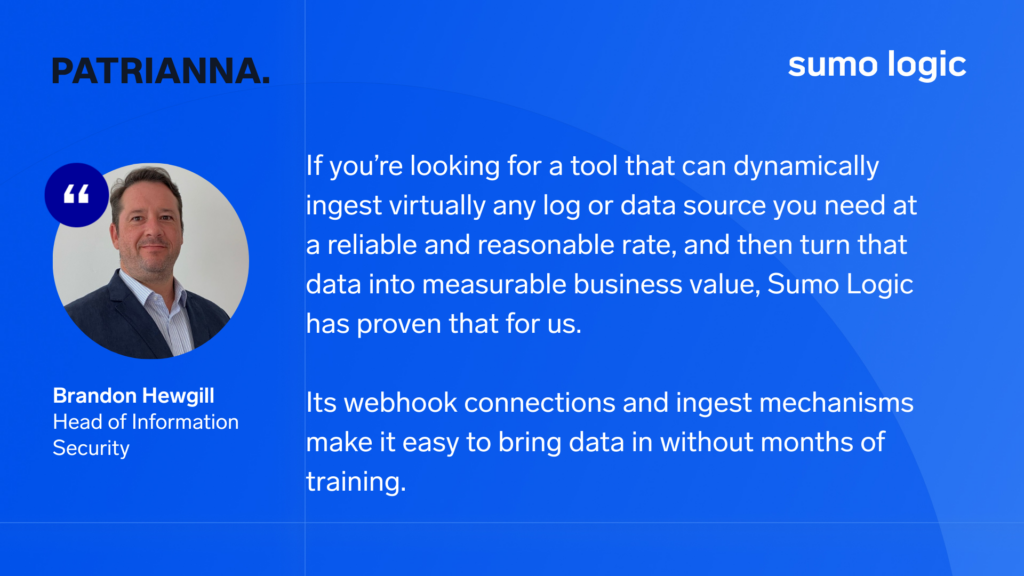
“With powerful query functions coupled with intuitive AI integration and Mobot, nothing is impossible — plus the ability to automate the reduction of noise within the platform to allow for more streamlined insights where and when you need it,” says Hewgill from Patrianna.
Work with a security partner, not another vendor
No matter where you are in your security journey, alert fatigue, tool sprawl, and infrastructure management are issues that most security teams deal with. And grappling with a legacy SIEM makes it that much more difficult.
More than just a security vendor, you need a partner you can work with that can scale, consolidate, and evolve with your security operations.
“The relationship we have with Sumo Logic has been amazing. It allowed us to build from a smaller remit and expand as we go. The pricing model works well for a small business like ours, where we don’t want to overcommit before we know exactly what we’ll use,” says Hewgill.
If your SIEM is creating more work than it eliminates, it might be time to rethink your security stack.
See what Sumo Logic can do for you. Set up a demo.