For years, security teams have dealt with the challenges of alert fatigue, endless tools and data sources, and constant context switching. But, so far, we haven’t been able to significantly improve it with traditional tools.
However, new agentic approaches can start providing improved gains. This begins to change the way SOC teams operate and approach managing their talent.
Respond faster with Sumo Logic Dojo AI
Cut through the noise, detect threats faster, and resolve issues before they disrupt your operations.
The challenges facing SOC teams
Overwhelmed teams: For a junior analyst, this is a constant pour. An alert comes in. They open their SIEM, then pivot to the EDR console, check the firewall logs, cross-reference threat intelligence feeds, jump into the ticketing system to document findings, and often need to escalate to a senior analyst to run a deeper investigation. Then it starts all over again, becoming repetitive and overwhelming.
Knowledge inconsistencies and unavailability: The true strength of a SOC lies in the knowledge held by senior analysts — tribal knowledge about threat patterns, investigation techniques, and environmental context that takes years to develop. When they’re unavailable or leave the team, that expertise is lost forever. However, their investigations are also lengthy and may not be consistent from one to another.
Deterministic approaches against evolving threats: Well-defined processes within SOC teams are critical, as they bring tried and tested approaches to different threat scenarios. But what happens when the threat landscape gets more complex? What happens when attackers use AI to work around existing known knowns? This requires much more than traditional playbooks and static automation. Junior analysts are left trying to build intuition from scratch for threats that no longer follow predictable paths.
Skills shortage: Hiring and retaining talent in the SOC has become increasingly difficult, especially for smaller teams where every analyst counts. How can security teams maximize the impact of the analysts they have? Teams need to automate repetitive work, freeing analysts to focus on more critical and strategic tasks.
Announcing the SOC Analyst Agent
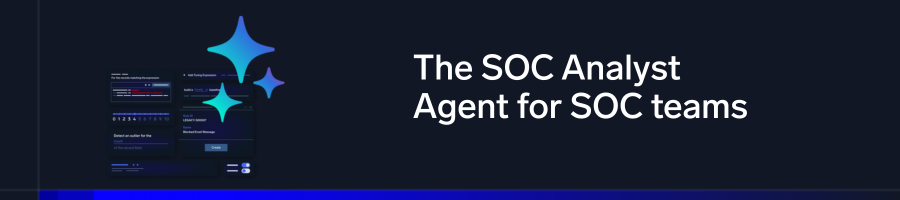
The SOC Analyst Agent, as part of Sumo Logic Dojo AI, integrates directly into your existing Sumo Logic SIEM workflow, acting as an AI-powered teammate for your analysts.
When an incident is triggered, the agent immediately goes to work, delivering:
Clear verdicts and explanations
The agent delivers a verdict based on past relevant SIEM and entity data and patterns. The SOC Analyst Agent doesn’t just provide recommendations; it provides guidance. Every verdict comes with clear, step-by-step explanations of how the agent reached its conclusion. Your analysts can see the reasoning, validate the logic, and build trust in the AI’s assessments over time.
Threat intelligence correlation and MITRE ATT&CK mapping
The verdict is enriched with threat intelligence correlation and automatically mapped to MITRE ATT&CK techniques, providing instant context about adversary tactics and potential attack progression.
Recommended severity
Based on its analysis, the agent provides a recommended severity level, helping analysts prioritize their response and allocate resources effectively.
AI-led investigation with a human in the middle
The Triage context becomes the foundation for deeper investigation. Analysts can review the agent’s findings, validate the conclusions, and conduct their own in-depth analysis with all the necessary context already assembled. This human-in-the-middle approach ensures that AI handles the repetitive triage work while human expertise drives the critical decisions.
Built for trust and collaboration
We designed the SOC Analyst Agent with a fundamental principle: AI should augment human expertise, not obscure it. It is not a black box they’re forced to accept.
When analysts review an incident, they see:
- The agent’s verdict and new severity recommendation
- Complete reasoning and evidence trail
- Correlated threat data and context
- The option to transition to Mobot to investigate further, explore context, and ask additional investigative questions
- Your investigations in your Mobot conversation history for future reference
This empowers your team to work faster without sacrificing the critical thinking that makes human analysts irreplaceable. Junior analysts learn from the agent’s methodology, while senior analysts can quickly validate findings and dive deeper where needed.
Why this matters for your SOC
For CISOs and SOC managers, the SOC Analyst Agent addresses critical operational challenges. It helps you:
Maximize your team’s impact
This isn’t about replacing analysts or cutting headcount. It’s about reinvesting human talent where it matters most. Senior analysts shouldn’t be stuck doing repetitive triage work all day. Let them focus on complex investigations, threat hunting, and strategic security initiatives.
Less experienced analysts can perform at higher levels with expert-level context and guidance built into every incident, effectively democratizing the tribal knowledge that typically takes years to accumulate.
Scale efficiently without burning out your team
You can handle growing alert volumes without needing to hire proportionally. By automating the tedious aspects of triage and eliminating tool sprawl, you enable your analysts to spend more time on engaging, high-value work. Through this, you improve retention and job satisfaction while acting as a force multiplier for your existing team.
Reduce MTTR through faster, better decisions
This is where it all comes together: by cutting through the noise with AI-powered triage, providing clear verdicts with context, and eliminating repetitive investigation work, your team can make faster, more confident decisions and resolve incidents faster.
Getting started
The SOC Analyst Agent is currently in preview. If you’d like to learn more, please contact your account team.
Curious about the other agents in Sumo Logic Dojo AI? See what they can help you do.