
We’ve shown how Mobot, Sumo Logic’s AI assistant, has grown from a search assistant into a thinking partner. It brought natural language to log analysis, monitors, and playbooks. We’re now bringing it to the heart of threat detection: SIEM detection rules.
Keeping detection coverage current is a never-ending job. New techniques appear, threat advisories land, and every rule needs tuning as your environment changes. Writing and updating rules by hand takes deep knowledge of your schemas, rule syntax, and expression builders, so that work often falls to a few senior engineers. The rest of the team waits, and gaps stay open longer than anyone wants.
Mobot now puts rule creation and tuning within reach of the whole team. Select Ask Mobot on the Cloud SIEM Rules page, or on any individual rule, and the conversation starts with the context of where you are.
What’s new
Mobot now supports four conversational capabilities for Cloud SIEM detection rules:
- Analyze: Ask about any rule in your environment, including built-in global rules and your own custom rules. Mobot explains what a rule does and how it is built, so you can understand why it fired.
- Create: Describe the detection you want, or pick a MITRE ATT&CK technique. Mobot asks for any missing details, such as fields, thresholds, time windows, severity, and tags, then proposes the full rule.
- Edit: Name an existing rule and describe the change, such as raising its severity or adjusting a threshold. Mobot shows what will change before it does anything.
- Close coverage gaps: Pick a technique and Mobot checks whether your existing rules already cover it. If they don’t, it offers to find a matching open-source Sigma detection and builds your rule from the one you choose.
Mobot works with the main SIEM rule types: match, threshold, chain, outlier, aggregation, and first seen.
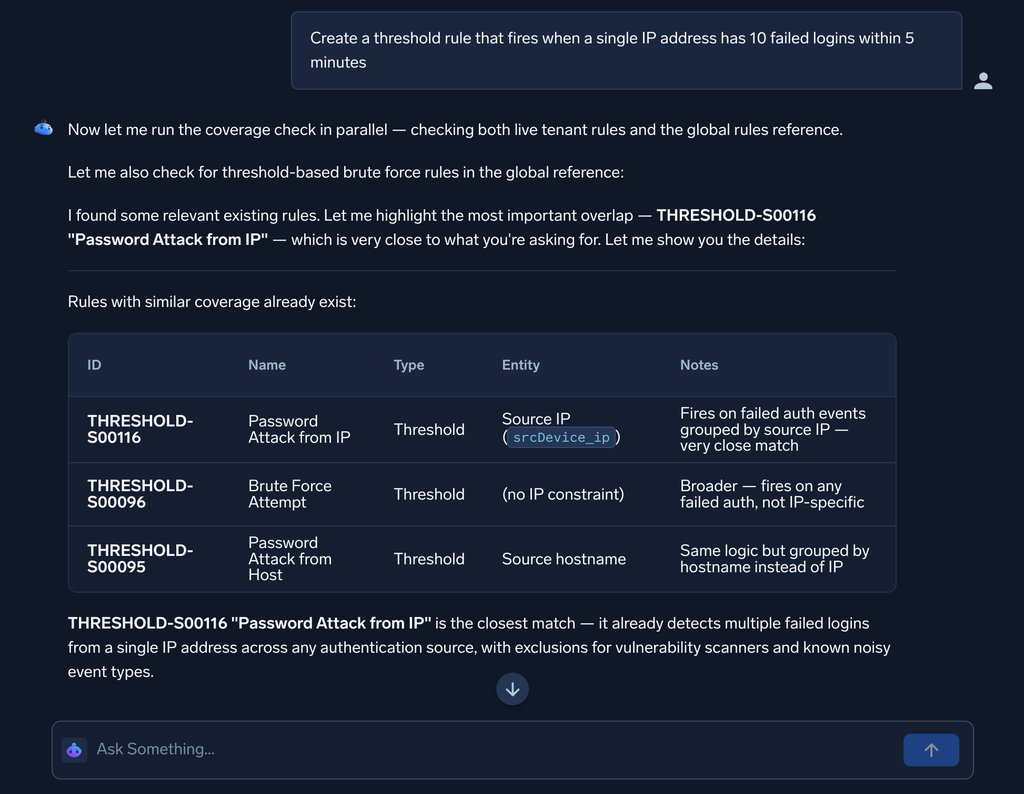
You stay in control at every step. Before Mobot proposes a rule, it checks that you collect the telemetry the rule needs. It scores each rule’s readiness and recommends prototype mode for new rules, which generates signals without creating alerts so you can validate a rule before you enable it. Mobot applies your existing role-based access controls and waits for your explicit confirmation before creating or changing any rule.
How Mobot closes a detection gap in minutes
Here is what the shift looks like in practice.
Example one: Covering a technique you’re missing
Context: A detection engineer reads a new threat advisory and wants to know whether the team is covered for the techniques it describes. In the old workflow, that meant manually searching the rule library, mapping each rule to ATT&CK, and then writing new logic from scratch for anything missing.
Starting prompt: “Do we have detection coverage for T1110, brute force?”
How Mobot tackles it: Mobot searches your system and custom rules for coverage of the technique. Finding a gap, it offers to look for a detection to fill it, and it surfaces the three closest open-source Sigma detections. The engineer picks one. Mobot checks that the required telemetry is collected, then proposes a rule with a name, description, expression, severity, and tags. The engineer asks for a higher severity, confirms, and Mobot creates the rule in prototype mode.
The result: The engineer goes from advisory to a rule running in prototype mode in one conversation, with a readiness check along the way. Nobody had to learn the rule syntax first.
Example two: Tuning a rule you didn’t write
Context: A SOC analyst keeps seeing a noisy rule that a colleague built last year. Before changing anything, they want to understand how it works.
Starting prompt: “Explain how this rule works, then change its severity from Medium to High.”
How Mobot tackles it: Mobot reads the rule and explains its logic and the expression behind it in plain language. When the analyst asks for the severity change, Mobot describes exactly what it will update and waits for a “yes.”
The result: The analyst understands the rule and updates it without editing it field by field in the UI. Senior engineers stay focused on threat research instead of routine rule changes.
Mobot lets you keep pace with the threats you face
Detection engineering has always rewarded deep expertise, and that expertise is scarce. Mobot lets more of your team contribute. Frontline analysts can inspect and draft rules. Detection engineers can turn emerging techniques into working rules faster. Security leaders can keep rule metadata consistent, because every rule goes through the same readiness check.
The result is a rule library that changes as fast as the threats do. The easier it is to create and tune rules, the less your coverage depends on who has time this week.
Try it for yourself
Conversational detection rule management is available today for Sumo Logic customers with SIEM. You need an active SIEM license and a role that can create, edit, and view SIEM rules. Check out the help docs and the release notes to get started.
Not yet a customer? Start a free trial to try Mobot for yourself.